


Chay river Dark cave
22:25 - 02.05.2025
Chay River – Dark Cave is considered an attractive eco-tourism route with a new type of tourism by yacht, exploring pristine caves without human hands, admiring beautiful natural scenery, enjoying comfortable relaxing moments when immersing yourself in the natural world, enjoying traditional dishes imbued with the local people. Chay River – Dark Cave belongs to the World Natural Heritage Phong Nha – Ke Bang National Park, about 50km northwest of Dong Hoi City on Highway 15.
>>Kayak Tour Chay River – Dark Cave, Paradise Cave
CHAY RIVER – DARK CAVE TRAVEL EXPERIENCE
To explore Chay River – Dark Cave, visitors can choose one of two routes. One is, from Phong Nha tourist boat station, go upstream of Son River through Phong Nha Cave about 1km to reach the river junction (Son River – Chay River – Trooc River). Take a boat along Chay River branch about 5km, visitors will reach Dark Cave, then end the journey at the boat station of Tro Mong ranger station. Second, visitors can go in the opposite direction, starting from the boat station of Tro Mong ranger station and ending at Phong Nha tourist boat station.
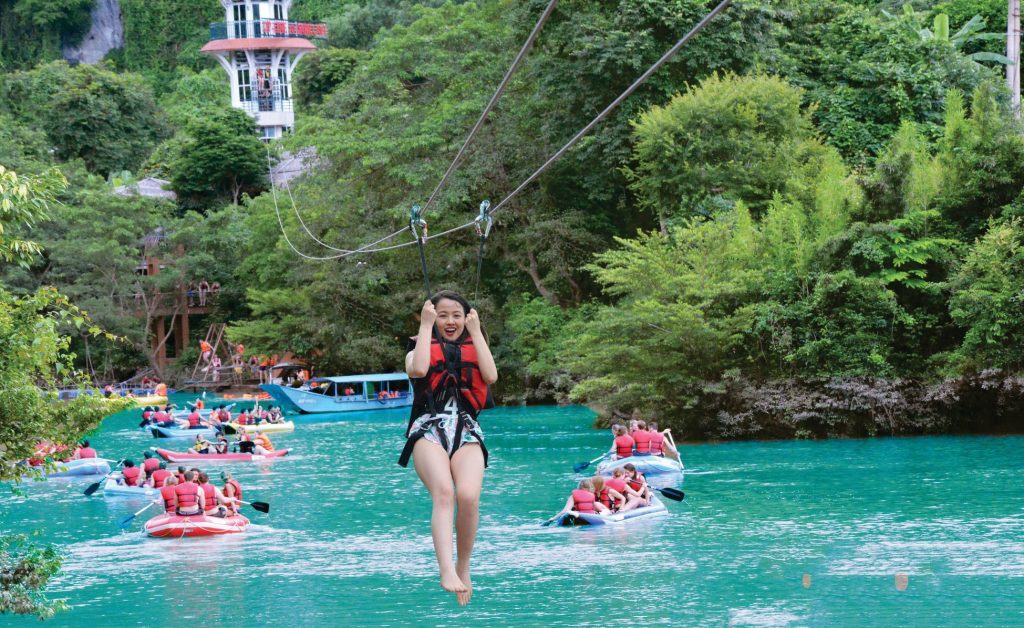
Chay River is one of the tributaries of Son River, originating from Chay Waterfall. The name Chay Waterfall comes from the sound of the waterfall flowing like the sound of a pestle pounding rice. With a length of only about 10km, Chay River has many beautiful rapids and contains diverse biological values with many aquatic animals typical of Phong Nha – Ke Bang National Park, of which two species of flower eel and flower sardine are in the world red book.

When taking a boat along the Chay River, we will feel the gentle, romantic flow with the clear blue water like jade with majestic ancient Karst towers. The river nestles under the majestic limestone mountains, quietly flows beside the canopy of ancient trees, then jumps through the cornfields on the deep green highlands. The Chay River is up to twenty meters deep in places, the riverbed is limestone sediments piled up on both banks. On both banks are corn fields stretching out, creating a charming landscape painting.
The river water is strangely blue, giving visitors the feeling that no other river water is as blue. Some researchers explain that it is due to the limestone mountains being eroded, calcium dissolved over millions of years, making the water endlessly blue. But there is also an opinion that a type of algae bacteria that eats the limestone of the river creates nitrogen that makes the river water blue. I don’t know which point of view is correct, but only when traveling on the Chay River can we feel its blue color is bluer than the sky. In each section of the river, the water has many different colors such as: turquoise, green, yellow…
The two banks of the river are connected by countless limestone banks. The water flows tirelessly since ancient times, carving the limestone into “architectures” that look very strange. In the morning, the ancient banyan trees reflect themselves in the river, showing off their shapes, as beautiful as a watercolor painting. Not only beautiful, Chay River also contains the most important fish fauna of Phong Nha – Ke Bang National Park. Species of ton fish, mat fish, climbing fish, eel, sardine and dozens of species of fish originating from the sea living here are the uniqueness of the river flowing between the heritage mountains and forests. There are two species of fish listed in the world’s red book living here, eel and sardine, which have surprised the world’s ichthyologists.
Cruising on the Chay River, in addition to admiring the majestic Karst mountains representing the terrain of Phong Nha – Ke Bang National Park, the corn fields or the yellow flower forests stretching on both sides of the river, visitors also have the opportunity to experience the cultural life of the indigenous people in the ancient villages along the river such as: Ha Loi, Na, Phong Nha, Tram, Me, Chay Lap… Visitors will encounter on this river wharf the image of young girls from Tram village, Me village (Son Trach, Bo Trach) every morning going to the riverbank to wash their clothes, looking at themselves in the magical blue color of the river water. The image of children playing on the riverbank makes us feel light and relaxed. The life and culture of the people living along the river for many generations is imbued with the soul of the Vietnamese countryside.
After cruising on the river, feeling the cool air and experiencing the cultural nuances of the villages on both sides of the river, visitors will be able to explore Dark Cave. Dark Cave is a branch of the Phong Nha cave system, surveyed by British Royal explorers in 1990 and 1992. The cave has a 20 meter wide and 40 meter high entrance. Like many caves in the Phong Nha – Ke Bang area, Dark Cave is both a water cave and a dry cave with a length of 5,258 meters and a height of 80 meters. Dark Cave is the name given by the British Royal cave exploration team, because the “dark light” in the cave is so dense that people feel like they can touch it.
The cave is still pristine with thousands of stalactites of diverse and unique shapes and is a shelter for many animals such as bats and swallows. In particular, the cave area is also a shelter for the Ha Tinh langur – one of the primates listed in the Red Book of Vietnam. Because it is located right next to the river, the humidity is high, so the stalactites in Dark Cave are covered with a large amount of moss, creating a characteristic green color.
On the side are streams of golden stalactites flowing to the foot of the cave, creating the impression of golden streams pouring down from the sky. The stalactites in the cave are not as majestic and magnificent as other caves, but they are standard samples of fossilized stalactites from ancient times. It is thanks to Dark Cave that scientists know that Ke Bang limestone mountain range originated from the ancient ocean. Tectonic movements from ancient times raised the seabed, billions of billions of shelled mollusks died, creating Ke Bang limestone mountain range, a world natural heritage today. Dark Cave is also the place that provides the most standard sample of a completely new crab species in the world, whose sample is currently on display at the Singapore Museum of Natural History.
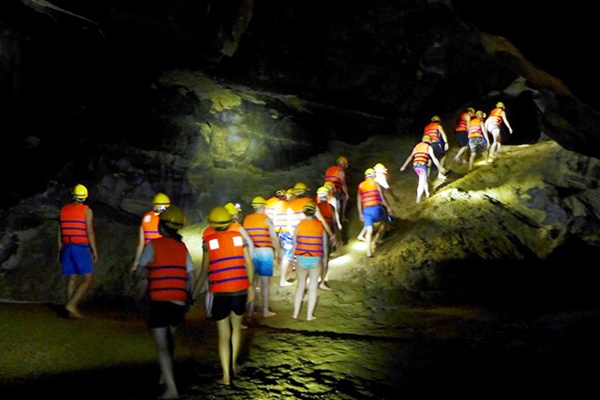
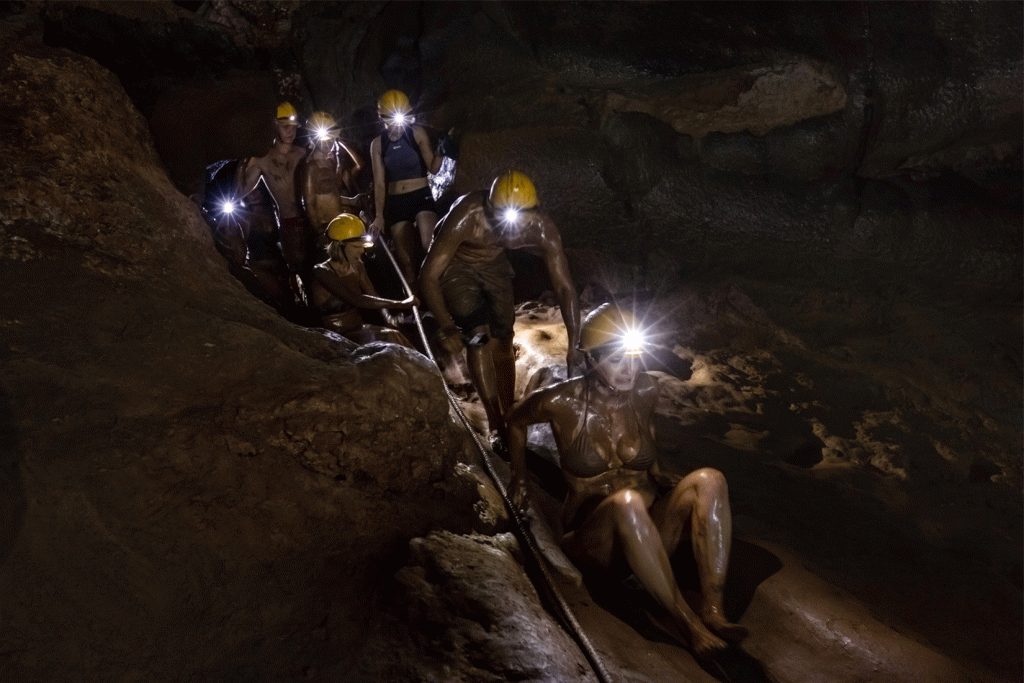
Visiting this 5km long cave is attracting interest from many people. Because this cave does not use tourism with a flashy lighting system, each individual entering here is assisted by a white light lamp attached to each person’s head to explore.
Green plants on stalactites in Dark Cave are a new and astonishing record for visitors. Why plants can live here is an interesting question. And the answer to this question also leads to interesting discoveries. It is a legendary story of plants and trees in a harsh living environment. Right behind the cave entrance is a giant stalactite column, its side receives sunlight, the light stimulates humidity and creates conditions for moss and algae to appear. From there, the fern shoots cling to and grow. But where the plants “have legs” to move into the cave is a story that researchers have just discovered. It is the wind that brings the fern shoots into every nook and cranny of the ancient stalactites.
The story of fern “migration” is due to natural factors, but their survival on stalactites is an experience that humans need to know. Scientists discovering ferns seeking nutrition from stalactites is an extraordinary story, their roots secrete an acid that erodes the outer layer of stalactites into organic humus and they get energy there with the same way of photosynthesis as plants do. Chay River – Dark Cave is not simply a landscape but truly a treasure trove of knowledge for those who want to explore geomorphology, geology and biodiversity.
Netin Travel
Share this post:


