

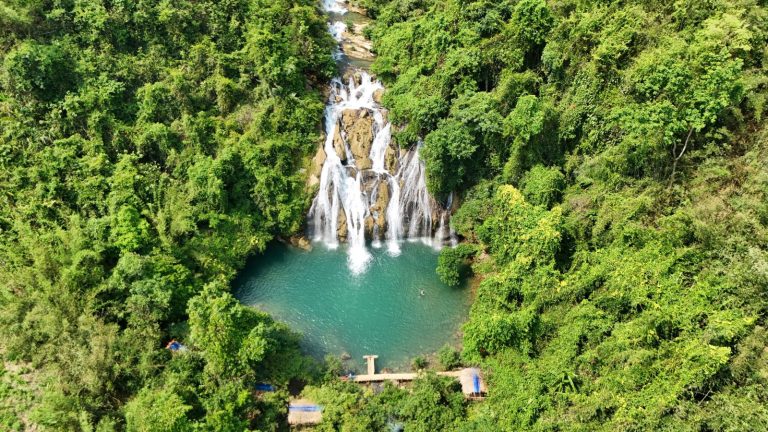
Ta Puong Waterfall Quang Tri: Discover the hidden gem in the mountains and forests of Huong Hoa
Quang Tri Province is not only known for its rich natural resources but also for its beautiful and pristine island system such…


23:06 - 30.04.2025
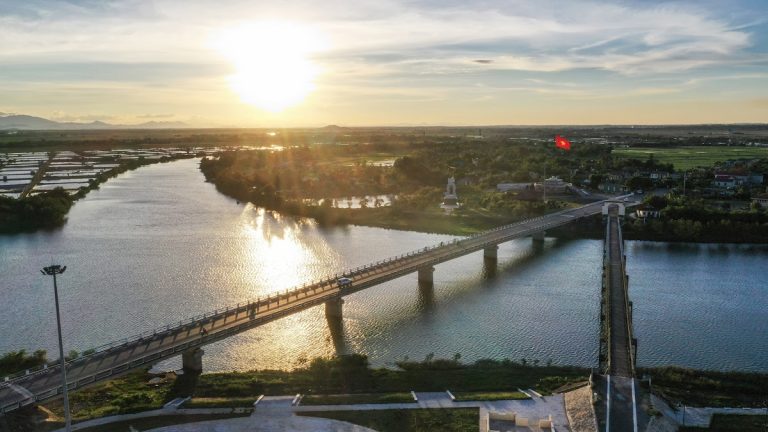
Hien Luong Bridge Ben Hai River is a tourist attraction that attracts many visitors when passing through Quang Tri. Hien Luong Bridge is located right next to National Highway 1A, making it convenient for visitors who want to visit this historical site.
Hien Luong Bridge was first built in 1928. The bridge was built by Vinh Linh district, mobilizing local people to contribute their labor. This bridge was made of wood, with iron piles, 2m wide. It mainly served pedestrians crossing Ben Hai River. In 1952, the French rebuilt a new bridge with 7 spans, 178m long, 4m wide, reinforced concrete piers, pine wood deck, 1.2m high railings on both sides, maximum bridge load of 18 tons.
Quang Tri Citadel, a special national relic

According to the Geneva Agreement, a demilitarized zone on the 17th parallel, from the mouth of the Ben Hai River running along the length of the river to the Vietnam-Laos border, would become a temporary military demarcation line dividing Vietnam into two regions, the South and the North. At that time, the Hien Luong Bridge across the Ben Hai River was also divided into two parts belonging to the two regions and painted in two colors: the half of the bridge belonging to the South (on the South bank) was painted yellow, the half of the bridge belonging to the North (on the North bank) was painted blue, the boundary between the two parts of the bridge was a 1cm wide white horizontal line.

Hien Luong Bridge was destroyed by American bombs in 1967. At this time, Hien Luong Bridge became a “symbol” of the division of the country into two regions, North and South.
In order to preserve the historical evidence of Hien Luong Bridge, Quang Tri Province has restored Hien Luong Bridge based on the design of Hien Luong Bridge built by the French in 1952. In particular, the bridge railing is painted in two colors, blue and yellow, to describe Hien Luong Bridge during the period when the country was still divided.
According to the provisions of the Geneva Agreement, there are 4 police stations along both banks of the Ben Hai River (the border river). Therefore, on the north bank of the river there are Hien Luong and Cua Tung police stations, on the south bank of the river there are Xuan Hoa and Cat Son police stations. The police stations are staffed by about 20 people, equipped with pistols and infantry submachine guns and are tasked with maintaining the demilitarized zone regulations, controlling people crossing the border, controlling each other in implementing the provisions of the Agreement and are placed under the supervision of the International Organization 76 (including representatives of Canada, India, Poland).

In 1967, two forts on the south bank of the river were destroyed by American bombs. To date, two forts on the north bank of the river still exist, but due to deterioration, Quang Tri province has restored them to their original form.
Hien Luong police station is located close to the bridge abutment on the north bank of Ben Hai river. The project consists of 3 buildings A, B and C forming a V shape. Building A (union building) is built in the style of a stilt house with dimensions of 12m x 6m, tiled roof, and installed with a glass door system. This used to be a meeting place and to receive delegations. Building B is 10m x 5m in size, made of wood, with a thatched roof, and is the residence of border police soldiers. Building C is 12m x 4m in size, used as a logistics warehouse and dining room.
From 1954 to 1967, the area on both banks of Hien Luong Bridge held a “flag competition” (both sides competed to build flagpoles to see which side could build the tallest). In the end, the victory belonged to the flagpole in the Hien Luong police station area, on the north bank. The flagpole was made of steel tubing, built in 1962, 38.6m high. On top of the flagpole was a flag measuring 9.6m x 4m.

The current flagpole is a model simulating the flagpoles that the Government and Army of the Democratic Republic of Vietnam had previously built. The flagpole is 28m high, made of 6 steel pipes connected together. On top of the flagpole is a five-pointed yellow star flag. On the body of the flagpole are rectangular steel bars to make a ladder. The flagpole is also equipped with a cable system, pulleys and a winch to facilitate the hanging of the flag. The base of the flagpole is circular, decorated with images depicting the history of the revolution.
Cua Tung Police Station is now part of the Border Guard Station 204 barracks. In addition to its function as a place for work and accommodation, this area also serves national security purposes. There is a traditional house displaying 92 photos and 60 artifacts directly related to the history of the revolutionary struggle of officers and soldiers of Cua Tung Police Station and other stations located along the northern bank of Ben Hai River from 1954 to 1967.
In order to simulate the demilitarized zone on the former 17th parallel as well as build a historical destination for tourists, educate revolutionary traditions for today’s and tomorrow’s young generations, Quang Tri province has built the Exhibition House “17th Parallel and the Aspiration for Unification” and the Monument Complex “Aspiration for Unification” on the south bank of Ben Hai River.

The exhibition hall “The 17th Parallel and the Desire for Unification” consists of 2 rooms. The reception room is where the statue of President Ho Chi Minh is placed. The room displays 53 documents and artifacts directly related to the fight of our army and people on both sides of Hien Luong – Ben Hai in the resistance war against the US to save the country. The documents and artifacts are divided into 4 topics: Geneva Agreement and the temporary military demarcation line; The indomitable spirit of Vinh Linh people and the fight to protect the borderline; People in the area south of the 17th parallel with the struggle for the desire for national unification; The 17th parallel after the liberation of Quang Tri in 1972.
In particular, this place also preserves a restored version of the 500W loudspeaker used by the Government and the army of the Democratic Republic of Vietnam on the northern bank in the past. Admiring this loudspeaker, visitors will partly imagine the “loudspeaker battle” on both banks of the Ben Hai River from 1954 – 1965.

The monument cluster “Aspiration for Unification” was built on an area of 2,700m², consisting of two parts. The base is made of many stone blocks of different sizes, decorated with reliefs. The monument is made of Thanh Hoa green stone with the following layout: in the front are two statues of a mother (7.70m high) and a baby (5.50m high) standing close together, depicting the image of a wife and child in the South, looking longingly towards the North when they could not cross the river to meet their husband, father and relatives during the years when the country was divided. Behind is a cluster of statues as a background, depicting the image of water coconut leaves.
In this area there is also a large campus, festival yard, lake, reception house, guard house, to serve the reception of visitors and promote the value of the relic.
Ben Hai River originates from Dong Chan Mountain in the Truong Son range, flows over a terrain of nearly 100km, along the 17th parallel from west to east and then flows into Cua Tung estuary.
The ferry piers on Ben Hai River include: Cua Tung (ferry pier A), Tung Luat (ferry pier B), Luy (ferry pier C), Thuong Dong and Duc Duc. Of which, Cua Tung and Tung Luat are two ferry piers that contributed significantly to the victory for independence and national unification of the Vietnamese people.

Cua Tung ferry (ferry A) is located in Cua Tung beach area (Cua Tung town). This is the anchorage place for ships and boats transporting cadres operating from 1954 – 1975. Currently, this ferry is planned in an area of 187.6m2, with a surrounding fence system. The memorial stele of the relic of ferry A consists of two parts: the pedestal and a complex of architectural and artistic images, prominently depicting the image of boats overcoming the storms to transport cadres and soldiers across the river and the aspiration for the happy day of national reunification.
Tung Luat ferry (ferry B) was formerly about 150m long, located in Tung Luat village, Vinh Giang commune (now Cua Tung town), 7km east of Hien Luong bridge and 2km west of Cua Tung beach. This was one of the secret anchoring points for ships and boats tasked with transporting cadres, soldiers, wounded soldiers, laborers and weapons and ammunition to the South bank, and was one of the main departure points of the transport route to support Con Co island.
The ferry terminal is currently planned to include a campus and a memorial. The memorial is a symbolic artistic complex, with the image of boats carrying soldiers and goods rushing forward despite enemy bombs and bullets.
In 1996, these ferry piers were ranked as national historical relics by the Ministry of Culture and Information (Ministry of Culture, Sports and Tourism).
The Hien Luong – Ben Hai historical relic complex was ranked as a National Monument in 1986 and a Special National Monument in 2013.
Hien Luong Bridge: “the flag battle”: According to the Geneva Agreement, each side had two police stations: Hien Luong Cua Tung station on the North bank, Xuan Hoa and Cat Son stations on the South bank. In the battles that took place at Hien Luong, “The Flag Battle” was probably the most intense and fierce battle that took place over the course of 14 years.
Since the demarcation line, the height of the flagpole has been constantly raised, because our flag cannot be lower than the puppet flag. When the red flag with yellow star was raised high, the people on both sides of the North and South rejoiced. The US and the puppet were completely surprised by this event. They quickly raised their flagpole to 35 meters. In order to not let our flagpole be lower than the enemy flag, in 1962 the government ordered the Vietnam Machinery Installation Corporation to fabricate a flagpole and then move it to Hien Luong to erect it. The flagpole was 38.6 meters high, raising a 134 m2 flag that weighed 15 kg. 10 meters from the top of the flagpole, there was a cabin for our soldiers to stand and collect the flag. This was the tallest flagpole on the demarcation line.

In 1965, the US launched a war of destruction by air and naval forces in the North. From here, the army and people in the North entered a new battle. On August 2, 1967, the enemy concentrated many groups of planes to take turns bombing for a whole day, causing the Hien Luong Bridge to collapse and our flagpole to break. That same night, we concentrated on rebuilding another flagpole with an electric pole and a wooden pole attached.
After each battle, the flagpole was broken, the flag was torn by bombs, the army and people of the North bank raised it again, many of our cadres and soldiers bravely sacrificed to protect the flag as the heart of the Fatherland. There are stories that have become legends about mothers mending flags on the banks of Hien Luong, told to future generations.
Hien Luong Bridge: “paint war”: Hien Luong Bridge is not only a flag battle, but also a paint war. Hien Luong Bridge was built in 1928, after many repairs, in 1952, the French colonialists rebuilt the bridge with a length of 178m, 4m wide; the bridge has 7 spans, the pillars are made of reinforced concrete, the bridge beams are made of steel, and the bridge surface is paved with pine planks. The dividing line between the North and the South is a 1cm wide white line that separates the two regions. Every day, the police and police of the two regions guard, taking turns back and forth according to a joint regime.

To create the image of a divided country, the US-Saigon government took the initiative to paint the southern half of the bridge blue. But with the desire to “unify the country”, they had just finished painting early in the evening, then at night, our police painted the northern half of the bridge blue to blend it into one color. After a while, they sent people to repaint the southern part of the bridge brown. Like that, Hien Luong bridge always changed colors. Whenever the enemy painted a different color to create two contrasting colors, we immediately repainted it into a common color. The paint color struggle on Hien Luong bridge is a form of political struggle to express the aspiration of our army and people to unify the country.
Hien Luong Bridge: “sound war”: Along the banks of Hien Luong during the years of division, in addition to chess and paint battles, there was also a sound war – loudspeaker war between us and the enemy. After the Geneva Agreement, in order to educate and motivate the people to fight for national reunification, we built a loudspeaker system, distributed into 5 clusters along the 1,500 meter length on the North bank. Each cluster had 24 25W speakers facing the South bank.

Every day, our loudspeaker system broadcasts programs from the Voice of Vietnam Radio Station, Vinh Linh Radio Station, music programs, poetry recitals, plays, and folk songs. Angry at this incident, a few weeks later, the US-Diem immediately installed loudspeakers made in West Germany and Australia on the South Bank with high capacity, blaring, overpowering our loudspeakers.
To “fight”, the US-Diem launched dangerous psychological warfare agents to Ben Hai. Every day they spoke from 14 to 15 hours, and at 1 or 2 in the morning they turned up the speakers at full capacity. In early 1960, a large American loudspeaker system was brought to the South bank. The Republic of Vietnam government believed that with this loudspeaker system, it would reach far to Quang Binh, and the people of the North bank would clearly hear the voice of national justice. Not giving up, the North bank added a loudspeaker system including a loudspeaker with a rim diameter of 1.7m, 4 250W speakers. The loudspeaker clusters were placed on solid reinforced concrete pillars, while the 500W speaker was placed on a mobile vehicle. By 1965, when the US bombed the North, the loudspeaker systems on both banks stopped working.
The war has ended, the country is peaceful and unified, and today the Hien Luong relic site still preserves images and relics. Historical relics associated with a time when the country was divided: Hien Luong Bridge, the flagpole on the North bank, the Union House, the Border Police Station, the “aspiration for unification” monument cluster. The “17th Parallel and the aspiration for unification” exhibition house on the South bank.

The land of bomb smoke in the past has now given way to vast rice fields, pepper fields, and endless green rubber forests. Visiting the Hien Luong – Ben Hai River is an opportunity for every Vietnamese person to recall heroic and tragic memories, each of us honors and deeply expresses gratitude for the great sacrifices of our ancestors for the independence and freedom of the Fatherland. The historical relics on the Hien Luong – Ben Hai River are the legacy of the Vietnamese people’s aspiration for national unification.
Along with Quang Tri tourist attractions such as Vinh Moc tunnels, Quang Tri ancient citadel, Truong Son cemetery, and Road 9 cemetery, it creates nostalgic tourism products for domestic and foreign tourists.
Some questions about Hien Luong Bridge Ben Hai River
Hien Luong Bridge was restored following the design of the iron bridge built by the French in 1952, with a length of 183.65m, a width of 5.50m, and a traffic section of 3.20m. The bridge began construction in 2001 and was inaugurated in 2008.
Hien Luong Bridge is located in Quang Tri province. Hien Luong Bridge crosses Ben Hai River, in Hien Luong village, Hien Thanh commune, Vinh Linh district, Quang Tri province.
Image: Collected
Share this post: