

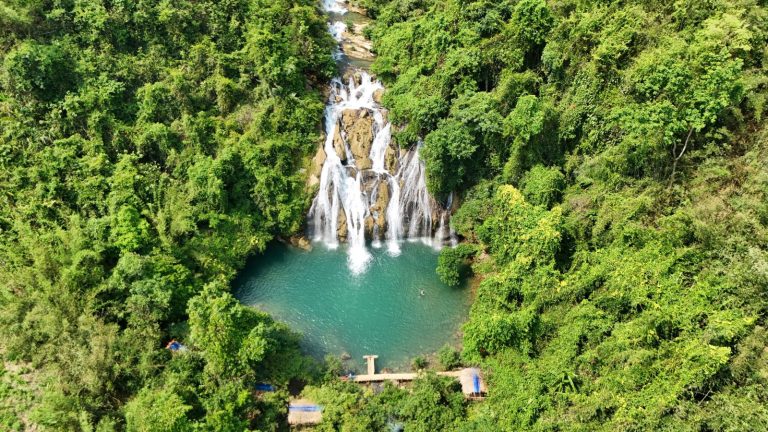
Ta Puong Waterfall Quang Tri: Discover the hidden gem in the mountains and forests of Huong Hoa
Quang Tri Province is not only known for its rich natural resources but also for its beautiful and pristine island system such…


11:26 - 23.11.2025
La Vang Pilgrimage Center is located in Hai Lang District, Quang Tri. La Vang Pilgrimage Center is the largest pilgrimage center for Catholics in Vietnam. This is also a Quang Tri tourist destination that attracts many domestic and foreign tourists.

There are many legends about the name La Vang. Among them, there are 2 famous legends that have been passed down to this day. During the reign of King Canh Thinh, the Tay Son Dynasty had a policy of opposing Catholicism. Therefore, to avoid punishment from the Tay Son Dynasty, many Catholics in the Quang Tri region fled to this land.

This is a remote mountainous area, so to communicate with each other, they have to shout loudly, and loud shouting makes the sound “resound”. That’s where the name La Vang came from.
Another explanation for the name La Vang is that when the parishioners fled to this land, they were hit by an epidemic. At that time, the Virgin Mary appeared and instructed them to find a type of vang leaf – drinking it would cure the disease. Writing “la vang” without accents becomes La Vang.
The name La Vang was born from then until now it has become a famous brand domestically and internationally.
It can be said that La Vang is a land full of the love of the Virgin Mary when she appeared to the people of God in 1798.
According to the Hue Archdiocese Documents – 1998, under the reign of King Canh Thinh (ascended the throne in 1792), with the edict banning religion on August 17, 1798, a number of believers near Dinh Cat hill (now Quang Tri town) had to find a place to hide. They took refuge in the La Vang mountain forest. In the sacred forest, poisonous water, difficult circumstances, lack of food, illness, fear of the army, fear of wild animals, the believers only knew to trust and rely on God and the Virgin Mary. They often gathered under the ancient banyan tree, praying together, comforting and helping each other.

One day, while everyone was praying the Rosary together, they suddenly saw a beautiful woman, wearing a long cloak, holding a newborn baby in her arms, with two angels holding lamps on either side. They immediately recognized the Virgin Mary. The Virgin Mary showed kindness, tenderness, and comfort to the parishioners so that they could be happy and endure hardship. She taught them to pick a type of leaf that was available nearby, boil it in water and drink it to cure their illnesses. The Virgin Mary also made a promise: “I have heard your prayers. From now on, whoever comes to pray to me at this place, I will hear them and grant them grace.”

Our Lady appeared in La Vang on the grass near the ancient banyan tree where the parishioners were praying. The parishioners present there all saw this miracle. After that, Our Lady appeared many times like that to support and comfort Her children in their suffering during the hundred years of persecution for their faith. It is also thanks to Her promise of grace that from the day Our Lady appeared in La Vang until now, many people have come here to ask for grace and to honor Her.
For Catholics, coming to the La Vang Pilgrimage Center makes them feel like they have reached a shore of peace in their souls, easing the difficulties in life.
The history of La Vang church was originally built on the foundation of a shrine to the Lady (possibly the Goddess Quan Am or the Goddess Lieu Hanh) for foresters. It was originally a thatched house under a banyan tree and fenced on all four sides. After the apparition of the Virgin Mary in 1789, it was given to the parishioners to build a place to honor the Virgin Mary.

In the center of this area, today there remains the bell tower of the La Vang Pilgrimage Center Basilica. This structure was built from 1924 to 1929, and was extensively renovated in 1959. In the summer of 1972, the Basilica was destroyed by war, leaving only the bell tower.

On August 15, 2012, the ceremony to lay the first stone for the construction of the new Basilica took place. In terms of size, this is the largest construction of the Vietnamese Church to date. The basilica was designed in the traditional Vietnamese East Asian architectural style, with a capacity of up to 5,000 people.

At the location where the Virgin Mary is said to have appeared near the ancient banyan tree, a monumental statue was built with the image of three banyan trees and Our Lady of La Vang in the middle. And the statue of Our Lady of La Vang is also placed in many places in this location.
The Virgin Mary is often depicted as a woman wearing a Vietnamese ao dai holding a baby also wearing traditional Vietnamese clothing.
In front of the bell tower of the La Vang Pilgrimage Center is a large square. On both sides of the square are the Stations of the Cross – a series of 14 sculptures depicting the progression of Jesus’ passion, from his condemnation to his crucifixion and finally his burial in the crypt.

In addition, within the pilgrimage center, there is also the La Vang Well, where every believer who comes here takes a sip of water to show respect to the Virgin Mary. Many believers believe that the well water has the ability to cure diseases in the body.
Having gone through many ups and downs of history and time, up to now, the La Vang Pilgrimage Center seems to radiate all its ancient beauty under a corner of the sky of Hai Lang – Quang Tri.
Every year on August 15th in La Vang, people often organize a pilgrimage festival, called “Kieu” (every 3 years there is a big “Kieu”, called “La Vang Festival”).

Pilgrims coming here can buy the leaves of the Vang tree, a type of leaf often used to make medicine or drink, cool, healthy and has antibacterial properties, very good for women after giving birth. Not only that, visitors from all over the world come here to make a pilgrimage and pray for blessings that Catholics believe the Virgin Mary will grant as they wish.

After a period of interruption, since 1990, the local government has allowed the ceremony to be held here again. La Vang has become the most important pilgrimage site for Vietnamese Catholics.
Pilgrims coming here can buy the leaves of the Vang tree, a type of leaf often used to make medicine or drink, cool, healthy and has antibacterial properties, very good for women after giving birth. Not only that, visitors from all over the world come here to make a pilgrimage and pray for blessings that Catholics believe the Virgin Mary will grant as they wish.

La Vang has become the most important pilgrimage site for Vietnamese Catholics, with more than half a million people coming on pilgrimage every year.
Today, La Vang is an attractive destination for Quang Tri tourism. In addition to visiting this place, tourists can also go to the nearby Quang Tri citadel to listen to explanations about the Vietnam War as well as the war at the citadel.
Share this post: