

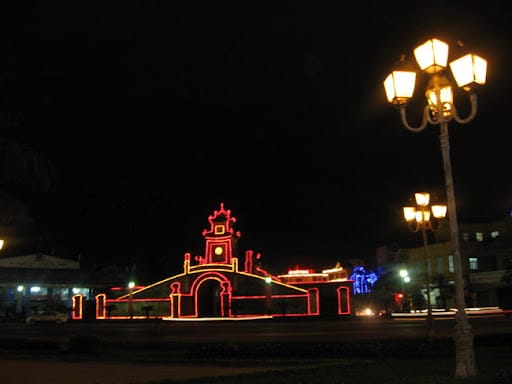
Quang Binh Quan is the symbol of Quang Binh.
Quang Binh Quan is located in the center of Dong Hoi city, Quang Binh province. Quang Binh Quan is considered a symbol…


12:21 - 07.03.2025
If the capital Hanoi has the Thang Long Imperial Citadel famous for its North Gate – the ancient citadel of Hanoi, Vinh city has the City Gate, the remaining evidence of the ancient citadel of Nghe An, then when traveling to Quang Binh you will know Quang Binh Quan – an ancient rampart system with unique architecture built to protect the Nguyen citadel.
Quang Binh Quan is a gate on the North-South highway (Ha road) belonging to the Luy Thay system, which dates back to the Trinh-Nguyen conflict, in Dong Hoi city, Quang Binh province. Luy Thay (King Thieu Tri of the Nguyen dynasty passed through this majestic Luy Thay system because he admired the ancestors’ achievements in defending the South and gave this rampart a new name, “Dinh Bac Truong Thanh”). This is an ancient rampart system built by Lord Nguyen in 1631 and was an important defense line during the Trinh-Nguyen conflict. Quang Binh Quan has now been restored.
In 1812, Loc Khe Marquis Dao Duy Tu, following the order of Lord Nguyen, designed and built this citadel with earth by the efforts of all the people here. In 1824, King Minh Mang asked a French officer to redesign it according to the architecture and appearance of a real military citadel: the citadel frame was shaped like a star fruit, with 4 large segments facing Southwest – Northeast, and 4 small segments facing Northwest – Southeast.
The perimeter of the citadel is 465 truong (1,860m) long, 1 truong (4m) high, the citadel surface is 1.35m wide, the foundation is 2m thick. At this time, the citadel was built entirely of high-fired bricks, mainly in 2 sizes: 0.3 x 0.3 x 0.06 m and 0.28 x 0.14 x 0.06 m, the mortar is molasses mixed with sand, not plastered.
Dong Hoi Citadel historical and architectural relic
During the Trinh – Nguyen conflict, Quang Binh Quan is considered an ancient rampart system built to help Lord Nguyen in Dang Trong fight against attacks by Lord Trinh in Dang Ngoai.
Located in the Luy Thay system that stretches over 30 km, guarding the vital North-South route and the waterway from Nhat Le estuary, Quang Binh Quan was built very solidly and firmly with a terrain leaning against the mountain near the stream. Perhaps thanks to that, more than 7 times the Trinh Lord’s army crossed the Gianh River to the South, all 7 times were stopped and failed at this pass.
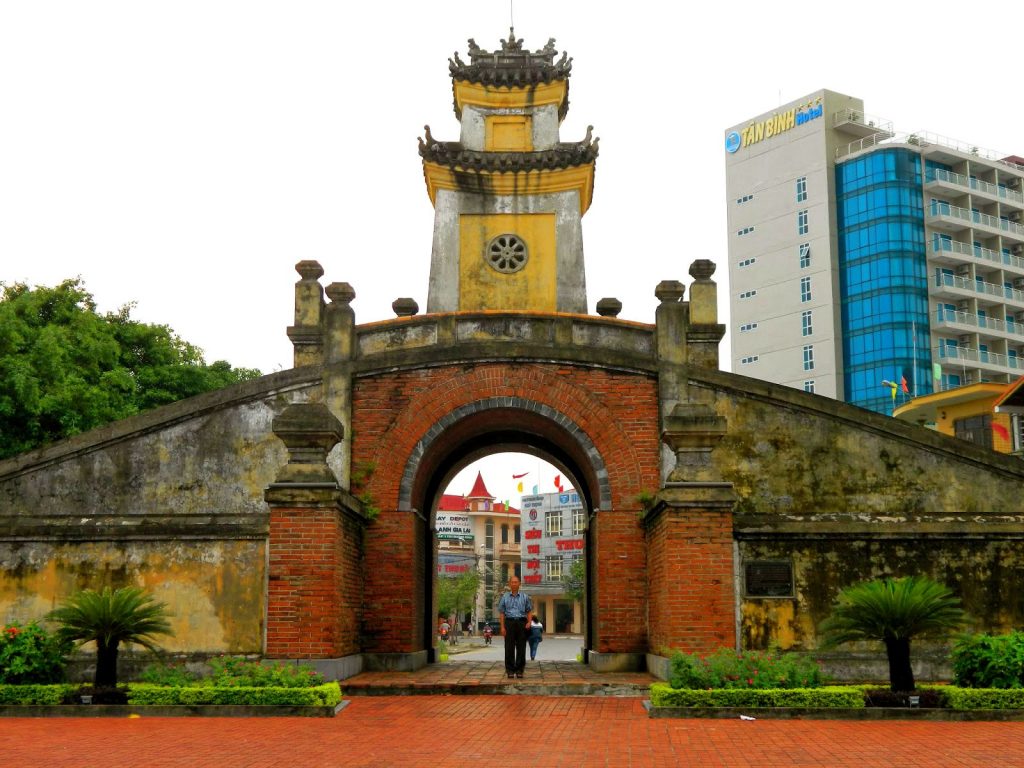
Not only was the defense strict against the Trinh lords, but for those from the North who wanted to enter Quang Binh citadel, if they traveled by land, they had to first go to Quang Binh Quan to present their papers and then go north to the Nam Mon gate to enter the citadel. Those traveling by water had to row a boat to Nhat Le gate, present their papers at Thu Ngu gate, then take the boat to the Dong gate to enter the citadel.
In 1825, King Minh Mang restored Quang Binh Quan by adding a watchtower, which further affirmed the solidity and magnificence of the rampart system. Quang Binh Quan was considered one of the most unique cultural and historical works in the country at that time. Furthermore, the king also ordered the embossment of the majestic image of Quang Binh Quan to be placed in front of The Mieu Temple in the Forbidden City.
During the resistance war against French and American invaders, it was attacked and heavily destroyed. However, this place still retains its extremely sacred architecture and ruins to this day.
Today, with the attention of the Government and the contributions and consensus of local people, it has been restored to its original architecture.
Basically, the citadel still has 3 gates, the remaining 2/3 of the southern citadel is relatively intact, only the northern citadel has completely collapsed, after repair, the size is only about 1,087 m with 15 zigzag sections.

Quang Binh Quan is a relic that has existed for hundreds of years, an important historical relic of Dong Hoi – Quang Binh land and is one of 32 works in the list of key cultural projects invested from 2001-2010.
Quang Binh Quan not only demonstrates a solid military system during the Trinh Nguyen period but also depicts the sophistication of a work of art that is hundreds of years old.
Coming to this historical architectural work, you can combine exploring other famous tourist destinations in Dong Hoi City such as: Mother Suot Monument, Tam Toa Church, Quang Phu Sand Dunes, Dong Hoi Night Market... to feel the beauty of nature, architectural art and people in this beautiful land!

Don’t forget to enjoy famous dishes such as: snakehead fish porridge, Bumalo hotpot, sea snake, blood cockles, dried squid, mackerel, soft dried weet potato, tapioca cake... these are Quang Binh specialties that make tourists remember and stay.
Come here, admire each unique architectural line, immerse yourself in the space of a sacred Quang Binh Quan to see how attractive this land is. Wish you a memorable, safe and meaningful journey to explore Quang Binh tourism!
Netin Travel
Share this post: